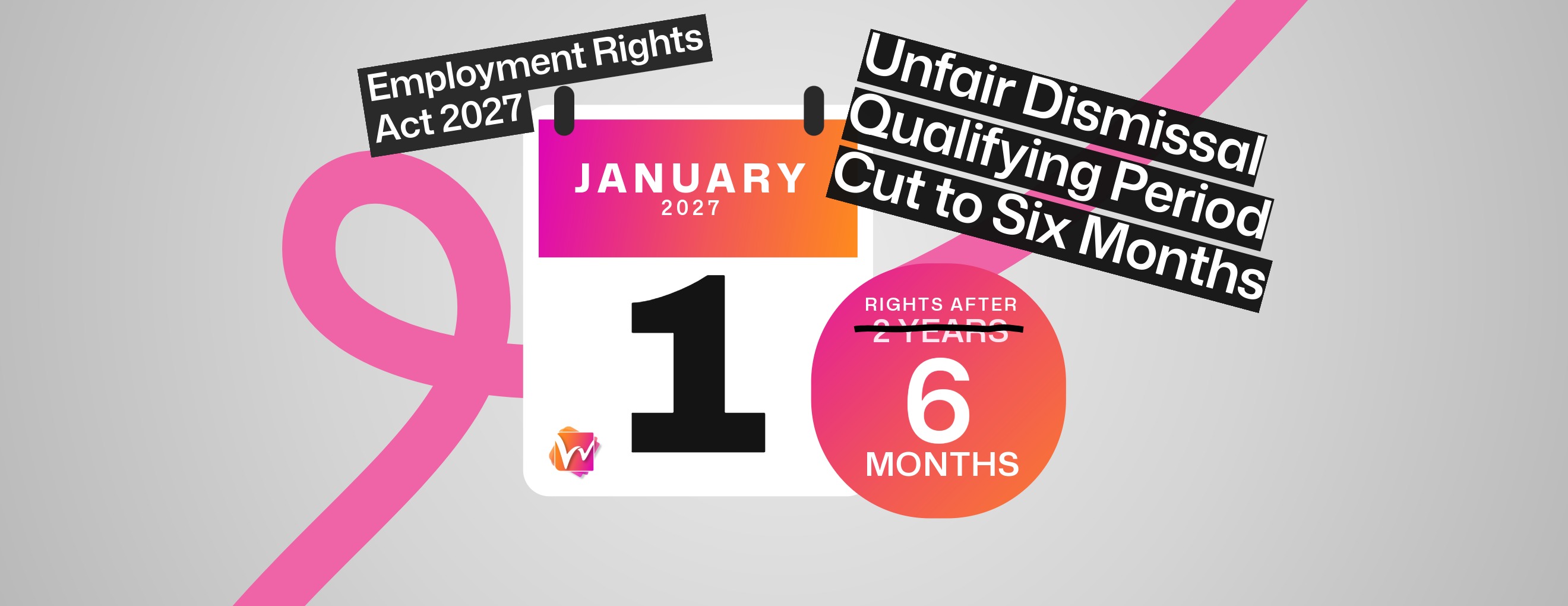
For more than a decade, employers have worked to a simple rule: most employees can't bring an ordinary unfair dismissal claim until they have two years' service. That rule ends on 1 January 2027.
Under the Employment Rights Act 2025, the unfair dismissal qualifying period drops from two years to six months. At the same time, the cap on unfair dismissal compensation is scrapped. Put together, these are the biggest changes to dismissal risk that UK employers have faced in years. At Warwick HR, we provide practical employment law support to help businesses prepare for changes like these.
In this article, we'll explain what's changing, who it affects and what you should do before the new year.
What is changing on 1 January 2027?
There are two changes, and both apply to dismissals where the effective date of termination is on or after 1 January 2027:
- The qualifying period for ordinary unfair dismissal falls from two years to six months. Once an employee has six months' continuous service, they can challenge a dismissal at an employment tribunal.
- The cap on the compensatory award is removed. At the moment, unfair dismissal compensation is capped at the lower of 52 weeks' pay or £123,543. From 1 January there's no statutory ceiling. Employees still have to prove what they actually lost, but for senior or highly paid staff, awards could be much larger than they are now.
This guide provides general information and should not be treated as legal advice for individual circumstances. Employment law is changing quickly, so if you're unsure how to proceed, we always recommend speaking to an experienced HR professional before taking action.
Who does the six-month rule apply to?
There's no transition period, and this is the point many employers miss. The new rule doesn't only apply to people you hire from January. It applies to everyone on your payroll with six months' service on 1 January 2027.
In practice:
- Anyone hired on or before 1 July 2026 will be protected from unfair dismissal from day one of the new regime.
- Anyone hired after 1 July 2026 will be protected as soon as they reach six months' service. For example, someone who started on 1 September 2026 will be protected from 1 March 2027.
- Employees hired in 2025 or early 2026, who until now had no ordinary unfair dismissal rights, will all gain them at once on 1 January.
If you've been relying on the two-year rule for people who joined in the last 18 months, that safety net is about to go.
Watch out for statutory notice
When you work out whether someone has enough service, any statutory minimum notice you didn't give is added on. For most employees with more than a month's service, that's one week. So if you dismiss someone without notice just before they reach six months, the added week can still push them over the line. The main exception is a genuine gross misconduct dismissal.
The same applies over the changeover period. Some employees dismissed without notice in the last week of December 2026 could still fall under the new rules.
What hasn't changed
Some things stay the same:
- Day-one claims still apply. Discrimination, whistleblowing and automatically unfair dismissal claims never needed two years' service, and they still don't.
- The fair reasons for dismissal stay the same. Capability, conduct, redundancy, statutory illegality and "some other substantial reason" are all still potentially fair, as long as you follow a fair process.
- The Acas Code of Practice still matters. A fair disciplinary process is now relevant to far more of your workforce, so it's worth reading the Acas Code of Practice on disciplinary and grievance procedures again.
Why this matters for your probation period
Many employers run a three-month or six-month probation period, extend it if needed, and then rely on the two-year rule as a second chance to deal with problems. That gap is closing.
From 2027, your probation period effectively becomes your only low-risk window. If someone isn't working out, you'll need to spot it, deal with it and make a decision well before the six-month mark.
Is your probation period the right length?
A six-month probation now lines up exactly with the qualifying period, which leaves no margin. Many employers are moving to a structured three- to five-month probation with formal reviews built in.
Do your managers actually hold probation reviews?
"We'll see how it goes" won't be good enough. Reviews at one, three and five months, recorded in writing, give you evidence and give the employee a fair chance to improve.
Can you extend probation?
Check your contracts. Extending probation doesn't stop the six-month clock, so it won't protect you on its own.
Seven things to do before 1 January 2027
With only weeks to go, these seven steps will help you reduce your risk and get ready for the new rules.
1. Identify who gains rights on 1 January
Pull a list of everyone hired between January 2025 and July 2026. These are the people whose employment rights change overnight.
2. Review open performance and conduct cases
If you're part-way through managing an issue with someone in that group, take advice now on how and when to proceed, and make sure the process would hold up as fair either way. Our disciplinary support can help you assess the circumstances before acting.
3. Tighten your probation process
Set clear objectives, hold regular documented reviews, and agree a decision point well before six months.
4. Update contracts and policies
Check probation clauses, notice periods, and your disciplinary and capability procedures. Our HR documentation services and handbooks and policies support can help you get these up to date.
5. Train your line managers
Most unfair dismissal claims are won or lost on how managers handle the process. They need to know what a fair procedure looks like and why paperwork matters. Our disciplinary and grievance training gives managers the confidence to do this well.
6. Raise the bar in recruitment
With less time to correct a bad hire, structured interviews, proper references and clear job descriptions matter more than ever.
7. Reassess your risk for senior hires
With no compensation cap, a poorly handled exit for a highly paid employee could be very expensive. Consider settlement agreements and specialist advice early.
Frequently asked questions about the unfair dismissal changes
What is unfair dismissal?
Unfair dismissal is when an employer ends someone's employment without a fair reason, or without following a fair process. From 1 January 2027, most employees with six months' service can bring a claim.
Is the unfair dismissal qualifying period still two years?
Only for dismissals that take effect before 1 January 2027. After that date, the qualifying period is six months.
Does a six-month probation period protect me from unfair dismissal claims?
Not on its own. Probation is a contractual arrangement, and the unfair dismissal qualifying period is a separate legal rule. An employee with six months' service is protected even if they're still on probation.
Is unfair dismissal compensation capped?
Not after 1 January 2027. The cap on the compensatory award (currently the lower of 52 weeks' pay or £123,543) is removed for dismissals from that date.
Does this apply to staff I hired before the law changed?
Yes. Anyone with six months' service on 1 January 2027 is covered, which includes everyone hired on or before 1 July 2026.
Need help preparing for the unfair dismissal changes?
The move to a six-month qualifying period will affect almost every UK employer, and the deadline is only weeks away. At Warwick HR, our CIPD-qualified HR professionals can help you audit your probation process, update contracts and policies, and manage difficult cases fairly before and after 1 January.
If you're unsure where you stand, get in touch with our team to discuss your circumstances and find out how our employment law support can help.